
How to Use Essential Oils on Skin the Right Way: Patch Test First, Then Pick a Kit
Before most people learn how to use essential oils on skin, they apply a favorite oil from the bottle. It seems logical, because the oil comes from a plant.
But Michele Buonomo and Erin Warshaw's review describes allergic contact dermatitis as a well-described complication of essential oil use, despite the widespread perception that natural ingredients are safe.
The review reports that approximately 80 different essential oils have been implicated in contact allergy (Current Dermatology Reports).
One skipped test can turn a calming routine into a red, itchy setback. That is why the patch test comes first, before any bottle touches your skin.
Below, you will learn how to patch test, dilute, and apply each oil with care, which starter kit fits your routine, and when a personal conversation saves you guesswork.
Test a small area first, dilute with a carrier oil such as fractionated coconut oil, and start with a kit that comes with usage directions.
What You Need Before You Start Using Essential Oils on Skin
You need a labeled oil, a carrier oil, and a small test area, plus a clear view of what essential oils can and cannot claim.
Check Your Oil, Label, and Skin Before You Begin
Read and follow the directions and cautions on each oil label. Choose a carrier oil, such as the Fractionated Coconut Oil in the Nature's Rx Kit.
A product's intended use decides whether it counts as a cosmetic or a drug (FDA). For that reason, this article covers safe application only and makes no health claims.
Before you trust any guide, ask what credential the guide holds, what quality standard sits behind its oils, and whether it offers a personal consultation.
Four Steps: How to Use Essential Oils on Skin With Less Risk
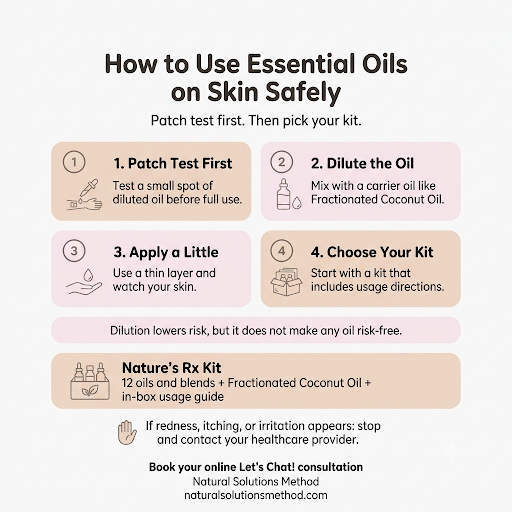
To use essential oils on skin safely, patch test a small area first, dilute the oil with a carrier oil, and apply a small amount while following your product label. Stop using the oil if redness, itching, or irritation appears.
Choose a kit that includes usage directions.
Step 1: Patch Test a Small Area First
Mix a small amount of the oil with your carrier oil. Apply it to a small spot of skin, and test each new oil on its own. Watch for redness, itching, or irritation.
For skin care products, dermatologists recommend testing on a quarter-sized spot, such as the underside of your arm or the bend of your elbow, twice daily for seven to 10 days (American Academy of Dermatology).
Use the same approach for your diluted oil unless your label says otherwise.
A clear patch test lowers your risk. It cannot promise that your skin will never react later.
Step 2: Dilute With Fractionated Coconut Oil
Dilution spreads the oil through the carrier, so less oil touches your skin at once. The Nature's Rx Kit includes Fractionated Coconut Oil and an in-box usage guide that shows how to use each oil as labeled.
Dilution lowers the concentration, yet it does not make an oil risk-free.
Step 3: Apply a Small Amount and Watch Your Skin
Apply a thin layer, and add more only if your skin stays comfortable. Keep every oil within its label cautions. If a reaction appears, stop.
After a reaction to a cosmetic product, the first step is to stop using it and contact your healthcare provider (FDA).
Step 4: Choose the Starter Kit That Fits Your Routine
Two kits suit a first purchase. The Nature's Rx Kit brings together twelve oils and blends, Fractionated Coconut Oil, and an in-box usage guide.
The twelve oils and blends are
Copaiba,
Frankincense,
Lavender,
Lemon,
Peppermint,
Tea Tree,
doTERRA Balance,
doTERRA Breathe,
Deep Blue,
DigestZen,
doTERRA On Guard, and
doTERRA Serenity, 5 mL each.
The Healthy Start Collection offers 5 mL bottles of the 10 most foundational doTERRA essential oils and proprietary blends.
Quality matters when you put an oil on your skin!
doTERRA is the only company with the CPTG label for Certified Pure Tested Grade® essential oils. Most other companies purchase their oils through middle men, who promise pure oils but almost always adulterate and dilute them.
So most brands are not actually pure.
doTERRA is the only company with the resources to test every batch of oils with over 50 different tests to ensure the purity. They are teaching labs around the country how to detect synthetic chemicals in essential oil. A couple of tests are not enough.
So don't trust other labels.
When Personal Guidance Beats Guesswork
A personal plan saves you from buying oils by trial and error, especially when you are unsure which oils fit your skin.
Signs You Need Personal Guidance Before Buying More Oils
Ask for guidance if you feel unsure which oils to start with, if your skin has reacted before, or if you want a plan that fits your whole family.
A qualified guide holds a recognized herbalism or wellness-advocate credential and explains what that credential covers. The guide also discloses the sourcing and quality standards behind each oil and offers a personal consultation to match the plan to you.
At Natural Solutions Method, you work with Jenni Wilson, a Master Herbalist and a Diamond-rank doTERRA Wellness Advocate with 13 years of experience in natural solutions and a mom of 7.
How Natural Solutions Method Handles Oil Selection
Natural Solutions Method offers a "Find Your Oils" guided session. The session determines which essential oils and products will best benefit you and how to use them in daily life.
You can also book a "Let's Chat!" personal consultation online, where Jenni answers your questions and guides you toward the right solutions for your needs.
Frequently Asked Questions
These answers cover the questions buyers ask most before they start.
Q1. Do I really need to patch test essential oils before using them on my skin?
Yes. Plant origin does not guarantee that your skin will tolerate an oil, and allergic contact dermatitis is a documented complication of essential oil use. A small test on a patch of skin shows you a reaction before you use the oil more widely, so you can stop early and choose a different oil.
Q2. Does diluting an essential oil make it completely safe on skin?
No. Dilution lowers the concentration on your skin, so it reduces risk, but it does not remove it.
Any essential oil can still irritate your skin or trigger an allergic reaction. You should still patch test, follow the label cautions, and stop using an oil if your skin reacts.
Q3. What comes in the Nature's Rx Kit?
The kit includes twelve 5 mL oils and blends, Fractionated Coconut Oil, and an in-box usage guide. Each oil is CPTG Certified Pure Tested Grade®.
Q4. What is the difference between the Nature's Rx Kit and the Healthy Start Collection?
The Nature's Rx Kit holds twelve oils and blends plus a carrier oil. The Healthy Start Collection holds ten foundational oils and blends in 5 mL bottles.
Q5. How do I find which oils fit my skin and routine?
Book a "Find Your Oils" session. The session guides you to the oils and products that suit you and shows you how to use them in daily life.
Your Next Step
Now that you know how to use essential oils on skin safely, patch test one oil first and give your skin time to respond. Start with a single oil, not the whole kit.
Next, choose the kit that matches your routine, and follow the usage guide that comes with it!
If you want a plan built around your skin and your family, Natural Solutions Method can match your oils to your needs through a personal conversation. Book an online "Let's Chat!" consultation to connect with me.


