
What Are Pure Essential Oils, and Why Does CPTG Testing Matter for Beginners Before You Buy
Many shoppers assume a bottle that says "100% pure" went through purity testing. The reality is different.
The FDA states that its regulation of aromatherapy products depends mainly on their intended use (FDA). A claim on the front of a bottle tells you little about the lab work behind the oil.
Pure essential oils for beginners contain only plant oil, with nothing added. A documented testing standard is the best way to check that claim. Without one, you rely on a slogan instead of a test result.
This guide explains what CPTG testing means and how to read an oil label. It also gives you a five-question checklist. You will see how Natural Solutions Method, led by Master Herbalist Jenni Wilson, helps beginners choose their first oils.
Pure essential oils need proof of testing, so ask for that proof first.
Pure Essential Oils for Beginners Simply Explained
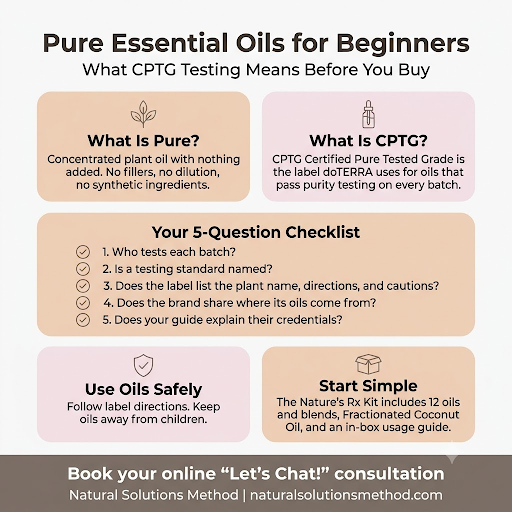
Pure essential oils are concentrated plant extracts with no fillers, dilution, or synthetic ingredients added. CPTG Certified Pure Tested Grade® is the label doTERRA uses for oils that pass purity testing on every batch, so you can check quality up front.
Core definition in plain language
An essential oil comes from the leaves, flowers, peels, or resin of a plant. A pure oil keeps that plant material and nothing else. A cheaper oil or a synthetic fragrance changes what sits in the bottle.
Testing methods exist to catch these swaps. A 2024 review of essential oil authenticity testing summarizes the sensory, physical, and chemical techniques used to assess quality and identify adulteration (Yang et al., Food Chemistry, 2024).
How CPTG testing works in practice
Natural Solutions Method teaches the CPTG standard because it ties purity to documented testing instead of wording on a label.
Here is the standard as Natural Solutions Method presents it: doTERRA is the only company with the CPTG label for Certified Pure Tested Grade® essential oils for beginners.
doTERRA is the only company with the resources to test every batch of oils with over 50 different tests to ensure the purity. They are teaching labs around the country how to detect synthetic chemicals in essential oil.
Why Pure Essential Oils Matter to Beginners
Purity matters most when you are new. You cannot judge an oil by smell yet. Misused oils also carry real risk, especially around children.
The cost of not checking
The essential oil market keeps growing. The global essential oils market was valued at $28.2 billion in 2025 and is projected to reach $56.3 billion by 2033 (Grand View Research, Essential Oils Market Size and Share Report, 2026-2033).
Growth brings more brands and more labels to compare. Safety deserves the same attention as purity.
Swallowed essential oils can cause effects ranging from nausea and vomiting to drowsiness, seizures, and coma, especially in infants and young children (Alabama Department of Public Health, 2025).
Read and follow the directions and cautions on every label. Store your oils out of children's reach.
Your five-question checklist before you buy
Ask these five questions of any brand:
Who tests each batch, and how many tests do they run?
Does the brand name a testing standard, such as CPTG Certified Pure Tested Grade®?
Does the label give the plant name, usage directions, and cautions?
Does the brand disclose where its oils come from?
Does the person guiding you hold a recognized herbalism or wellness-advocate credential, and will they explain what it covers?
Common Misconceptions About Pure Essential Oils
Two common beliefs trip up beginners: that natural means safe, and that any purity label proves quality.
Misconception 1: "Natural means safe"
Plant oils are concentrated. Dose and method matter. A small bottle holds a strong plant extract, so treat it like any potent product.
Follow each label's directions for aromatic, topical, or internal use. Purity tells you what is in the bottle. It does not tell you how much is safe for you or your family.
Misconception 2: "Any purity label is enough"
Natural Solutions Method shares this position on purity: most other companies purchase their oils through middle men, who promise pure oils but almost always adulterate and dilute them. So most brands are not actually pure.
A couple of tests are not enough. So don't trust other labels!
Whichever brand you consider, ask what testing stands behind its label. Compare the answers with the checklist above.
How Natural Solutions Method Helps With Pure Essential Oils for Beginners
Natural Solutions Method pairs CPTG-tested doTERRA oils with personal guidance from Jenni Wilson, a Master Herbalist and Diamond-rank doTERRA Wellness Advocate.
Starter kits built around CPTG oils
The Nature's Rx Kit brings together twelve 5 mL oils and blends:
Copaiba,
Frankincense,
Lavender,
Lemon,
Peppermint,
Tea Tree,
doTERRA Balance,
doTERRA Breathe,
Deep Blue,
DigestZen,
doTERRA On Guard, and
doTERRA Serenity.
The kit also includes Fractionated Coconut Oil and an in-box usage guide. The guide shows how to use each oil aromatically, topically, or internally as labeled. Each oil is CPTG Certified Pure Tested Grade®.
The Healthy Start Collection offers 5 mL bottles of the 10 most foundational doTERRA oils and blends.
What the Find Your Oils session covers
Find Your Oils is a guided session that helps you decide which oils and products suit you and how to use them in daily life.
Jenni, the Natural Oil Mom, also teaches gut health through the Foundational Wellness Class. The class uses natural solutions powered by essential oils.
Frequently Asked Questions
These answers cover common beginner questions.
Q1. What does CPTG mean on an essential oil label?
CPTG stands for Certified Pure Tested Grade®. doTERRA uses this label for oils that pass its purity testing. Natural Solutions Method teaches that over 50 different tests check each batch for purity and detect synthetic chemicals.
Q2. How can I tell if an essential oil is pure?
Marketing language alone says little about testing. Use the checklist above. Ask the brand which testing standard it follows, and choose a guide who explains their credential and sourcing.
Q3. Which pure essential oils should a beginner buy first?
A kit suits many beginners. It gives them several oils and a usage guide at once. Your goals decide which fits best. A Find Your Oils session can match a kit or single oils to your needs.
Q4. Are pure essential oils safe for kids and pregnant women?
Purity does not equal safety. Follow every label's directions and cautions. Keep oils away from children. Talk to your healthcare provider first if you are pregnant, nursing, or managing a health condition.
Your Next Step With Pure Essential Oils
Pure essential oils begin with proof of testing, not a bold claim on the bottle. Use those five questions on every brand you consider. Read each label's directions and cautions before you open a bottle.
The Nature's Rx Kit gives you twelve CPTG-tested oils and blends with an in-box usage guide as a ready starting point. Start with the questions, not the bottle. You will choose with a clear standard in hand.
Book your online "Let's Chat!" consultation today and connect with me to find the oils that fit your family.


